Annapurna Circuit Trek Under $650 (Cost Breakdown)

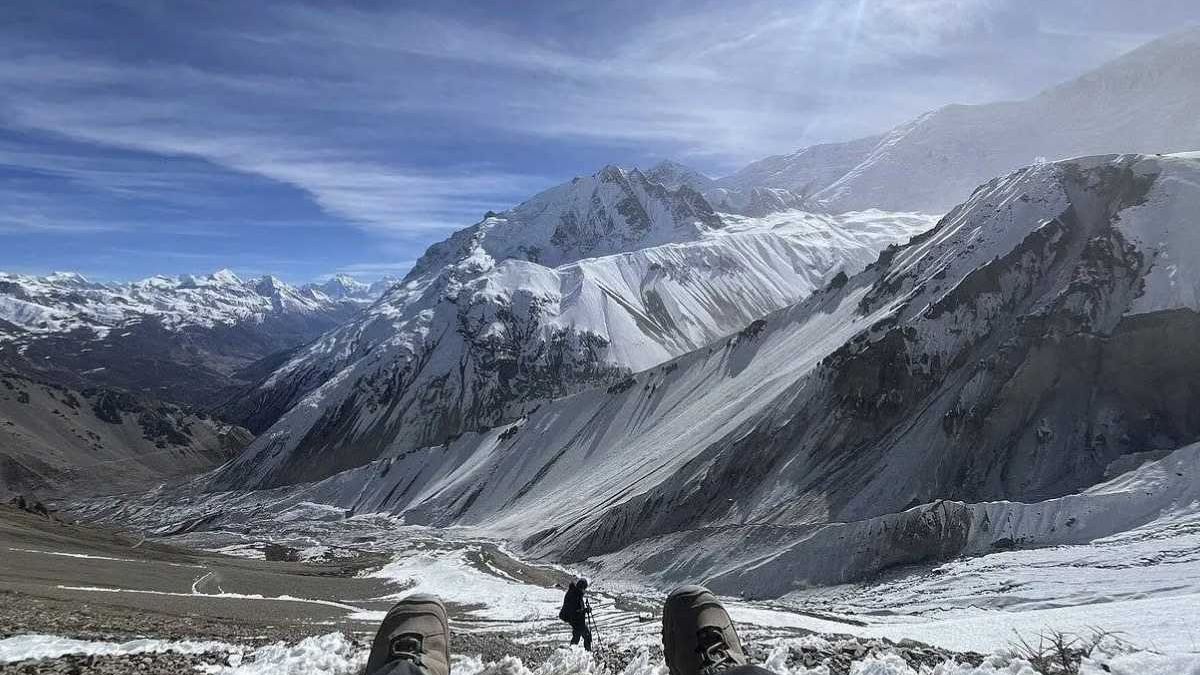
Full Annapurna Circuit trek cost breakdown for a 9-day guided trip. What the permits, guide, and logistics actually cost, what you control on the trail, and how to do it under $650.
The Annapurna Circuit trek is one of the most iconic trekking routes in the world and also one of the most misunderstood when it comes to cost.
When you search online, you'll find estimates anywhere from $500 to $2,000+. That range is so wide that it's barely useful. The truth is, the Annapurna Circuit trek cost depends heavily on how it's structured, what's actually included, and how much control you have over your daily spending on the trail.
This post first covers what a typical Annapurna Circuit budget looks like and what the main cost components are. Then it shows how a 9-day guided ACT can be done for under $650 using Nepwise's pricing model as a reference, with the actual numbers.
What Does the Annapurna Circuit Trek Typically Cost?
For most international trekkers, the total Annapurna Circuit trek budget falls somewhere between $600 and $1,500 per person for a well-managed experience. The variation comes from a few key factors: number of days, type of operator, accommodation standard, and whether daily spending like food is bundled into the package or paid separately.
Here's how the main cost components break down in general:
Permits and fees are fixed regardless of operator. The Annapurna Circuit requires two mandatory permits, including the ACAP (Annapurna Conservation Area Permit) and the TIMS card, although there are still uncertainties around the TIMS card. For international trekkers, these together cost around NPR 5,000 (roughly $37–38). Most operators include these in their price, which is fine as these are part of the fixed logistics and need to be arranged by licensed operators.
Guide fees vary by operator and experience level. A licensed trekking guide for a 9-day circuit typically ranges from $150 to $250 depending on the company and season.
Transportation covers getting from Kathmandu to the trailhead (usually Besisahar or Chame) and from the endpoint back to Pokhara. This is often underestimated in budget planning.
Accommodation on the Annapurna Circuit is teahouse-based. Prices range from NPR 300–800 per night depending on elevation and season. Most operators pre-book these to ensure availability, especially during October–November and March–May peak seasons.
Food and drinks is where most of the daily variation sits. A comfortable daily food budget on the trail runs $20–35 per day depending on altitude and eating habits. Over 9 days, that's roughly $180–315.
When bundled together, for a 9–10 days itinerary, many operators quote a single all-inclusive price in the $700–1,200 range without breaking down what's what. This makes it hard to evaluate whether you're getting fair value or paying unnecessary hidden markups.
Low-budget Annapurna Circuit Trek: How Nepwise Structures the Costs Under $650
Nepwise takes a different approach from most operators. Rather than quoting one bundled price, costs are separated into what fixed cost you pay upfront and what flexible costs you manage yourself on the trail.
The following costs are based on the 9-Day Annapurna Circuit Trek Itinerary
Base Package (the fixed logistics): $355 per person
This covers everything that needs to be arranged before the trek starts:
- Licensed guide and logistics support
- All permits and fees
- Transportation—Kathmandu to trailhead, and Muktinath to Pokhara at the end
- Pre-booked accommodation along the route
This is fixed. It's what you pay once in advance.
Add-ons (optional, manageable yourself): Variable cost
1) Food and Drinks: $180–270
On the Nepwise pricing for ACT, it shows Food & Drinks as an add-on at $270 per person for 9 days. If you select this, it's added to your booking total — bringing the default plan to $625 per person, inclusive of taxes. So if you want an extra convenience of not paying for your meals by your hands on the trek, you can add this add-on to your package.
But this is where it gets interesting for budget-conscious trekkers.
If you are budget-conscious, you would likely spend less than the $270 figure. So it is better to not include it in the package, rather, keep at least $270 (in equivalent Nepali cash rupees) in your pocket for the 9 days of the itinerary. If you spend less, you’ll bring back the money.
You pay teahouses and local lodges directly for everything you eat and drink, based on what you actually order.
This model gives you something most bundled treks don't: real flexibility and independence on the trail. You decide what to eat, how much, and when. You're not locked into a fixed meal plan or paying in advance for food you may not consume. If you want to enjoy a hot apple pie at a lodge in Manang, go for it. If you'd rather keep it simple with dal bhat twice a day, that's your choice too.
For practical planning, we always recommend carrying at least the equivalent of $270 in Nepali cash before you start the trek. That's a realistic buffer. In practice, many trekkers who eat simply come back having spent noticeably less.
2) Shared Porter: $90 per person (optional)
This is an optional add-on. The 9-day circuit involves sustained elevation gain and a high-altitude pass crossing at 5,416m. Whether you need a porter depends on your pack weight and how you feel about carrying a load at altitude.
If you're packing light (12 kg or under) and are reasonably fit, most trekkers manage without one. If your bag is heavier or you want to fully focus on the experience without the physical load, $90 is fair for 9 days.
Food Costs by Altitude: What to Actually Expect for Budgeting
Understanding how food prices change along the route helps you budget more accurately than a flat daily average.
Days 1–4 (Kathmandu to Manang) are at lower to mid-elevations. Teahouse meals are cheaper here. Dal bhat for around NPR 400–600, a bowl of noodle soup for NPR 250–400. These are your cheaper days.
Days 5–8 (Manang to Thorong La to Muktinath) are where prices rise meaningfully. At Yak Kharka, High Camp, and Muktinath, expect to pay significantly more for the same meal — sometimes double. Everything is carried up by human and animals, and the pricing reflects those efforts and resources.
Day 9 is mostly a drive back to Pokhara, so food costs drop again.
A few things that keep daily costs down regardless of elevation: dal bhat (cheapest filling meal, often unlimited), plain tea or hot lemon over packaged drinks, and a water purification tablet so you're not buying bottled water every few hours.
Real Budget Scenarios
1) Lean budget — food-conscious, no porter:
| Item | Cost |
|---|---|
| Base Package (guide, permits, transport, accommodation) | $355 |
| Food & Drinks (simple eating) | ~$190 |
| Total | ~$545 |
2) Default plan — average food spending, no porter:
| Item | Cost |
|---|---|
| Base Package | $355 |
| Food & Drinks | $270 |
| Total | $625 |
3) Comfortable — average food, porter included:
| Item | Cost |
|---|---|
| Base Package | $355 |
| Food & Drinks | $270 |
| Porter Service | $90 |
| Total | $715 |
The under $650 target is comfortably achievable without a porter, and still reachable with the porter service if you eat simply.
Final thoughts
A guided Annapurna Circuit Trek doesn't have to cost $1,000+. The under $650 figure is realistic, and the path to it is simply understanding what's fixed and what you control. And the 9-day itinerary is indeed one of the most demanded one in 2026 and beyond.
For a solo traveler, at $355 for all the essential logistics (guide, permits, accommodation, transportation) and roughly $190–270 for food/drinks depending on how you eat, the total comes in between $545 and $625 for most trekkers. Add a porter if you need one and you're still close to or under $650. Importantly, as your group size increases, the cost comes down even further.
What makes this work is knowing the difference between organized costs and personal costs, and having the freedom to manage the latter yourself, on the trail, based on what you actually want.
Note: The costs and prices mentioned are as of the date of writing this article.

Sanjiv Jaiswal
Co-founder | Technology & Growth Lead
Sanjiv leads technology and growth at Nepwise.
He works closely with guides, operators, and trekkers to design systems that bring clarity to trekking and travel logistics, pricing, and planning. His work focuses on making complex aspects of trekking in Nepal more transparent and understandable.
He is part of the team building Nepwise Adventures around the belief that adventure travel in Nepal should be easier to understand, more transparent, and centered on helping travelers make informed decisions.