Trekking Permits for Annapurna Region
If you are trekking in the Annapurna region, trekking permits are mandatory for all routes, whether you are walking short trails or longer high-mountain treks.
These permits allow access to protected conservation areas and help manage trekking activities responsibly.
How Permits Are Handled with Nepwise
When you trek with Nepwise Adventures, all required trekking permits are arranged for you in advance. You do not need to visit government offices, fill out forms, or manage any paperwork yourself.
Once your booking is confirmed and we receive your passport details, the Nepwise team processes the permits before your trek begins. Your guide carries the permits during the trek and presents them at checkpoints when required.
You only need to carry your passport on the trail. Everything else is handled for you.
Required Trekking Permits for the Annapurna Region
To trek in the Annapurna region, two permits may apply, depending on the route and current enforcement.
Annapurna Conservation Area Permit (ACAP)
The Annapurna Conservation Area Permit (ACAP) is required to enter and trek within the Annapurna Conservation Area.

"Annapurnaa Conservation Area Project (ACAP) Permit"
This permit supports:
Conservation of natural landscapes and wildlife
Maintenance of trekking trails
Local community development within the region
Permit cost:
For non-SAARC/international trekkers: NPR 3,000 (~USD $22) per person
For SAARC nationals: NPR 1,000 (~USD $7) per person
ACAP is required for all Annapurna treks, including routes such as Annapurna Base Camp, Annapurna Circuit, Ghorepani Poon Hill, and Khopra Ridge.
TIMS Card (Trekkers’ Information Management System)
The TIMS card has traditionally been part of trekking regulations in the Annapurna region.
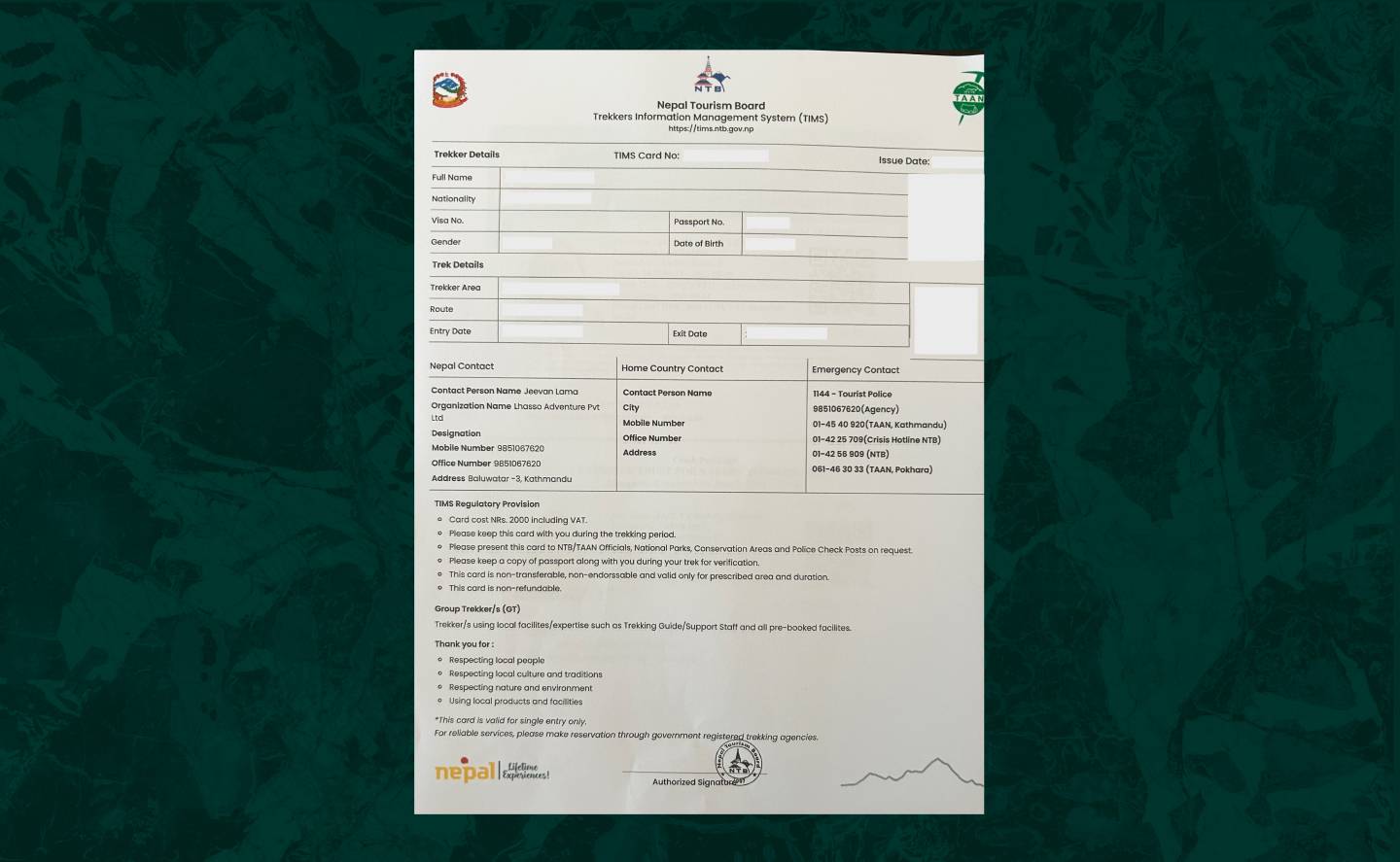
"Trekkers’ Information Management System (TIMS) Card"
At present, government enforcement of the TIMS requirement has been inconsistent, and there is no clear nationwide confirmation that it is strictly enforced on all Annapurna routes.
However, to avoid any uncertainty at checkpoints, Nepwise recommends arranging the TIMS card.
If the TIMS card is not required for your specific route at the time of trekking, Nepwise will inform you in advance. If it is required, we ensure it is already arranged so there are no delays on the trail.
Do You Need Any Other Permits?
For standard Annapurna region treks, no additional permits are required beyond ACAP and the TIMS card.
If a trek includes restricted or special areas, Nepwise will clearly inform you in advance and handle any additional permit requirements.
Annapurna Region Trekking Permit Costs (Summary)
Permit Name | For non-SAARC/international trekkers | For SAARC nationals | Notes |
|---|---|---|---|
Annapurna Conservation Area Permit (ACAP) | NPR 3,000 (USD $22) | NPR 1,000 (USD $7) | Mandatory for all Annapurna region treks |
TIMS Card | NPR 3,000 (USD $22) | NPR 1,000 (USD $7) | Currently optional; arranged for safety |
These fees are fixed by authorities and apply to all trekkers, regardless of route or trek duration.
Where Annapurna Region Permits Are Issued
Annapurna region permits are issued by official authorities before or at the start of the trek. For reference, permits are typically processed in:
Kathmandu
Pokhara
When trekking with Nepwise, you do not need to visit these offices yourself. Permits are arranged in advance once your booking is confirmed.
Documents Required
To process trekking permits, only basic personal information is required:
A valid passport copy
Accurate personal details such as name, nationality, and date of birth
Passport photos are generally not required, as permits are commonly processed digitally. If anything additional is needed, the Nepwise team will inform you in advance.
Permit Checks Along the Trail
Permit checks are conducted at official checkpoints along Annapurna trekking routes. These checks are routine and usually quick.
Your guide handles all communication with checkpoint officials, so checkpoint checks do not affect the trekking schedule.
Why These Permits Matter
Trekking permits help support conservation efforts, trail maintenance, and local community development in the Annapurna region.
By trekking with valid permits, you contribute directly to protecting the landscapes and communities that make trekking in the Annapurna region possible.
Last updated: May, 01, 2026