What Costs Are Fixed vs Flexible When Trekking in Nepal?

Not all trekking costs in Nepal work the same way. Here's a clear breakdown of what's fixed before you trek, what's flexible on the trail, and why the difference matters for your budget.
If you've been researching trekking in Nepal, you've probably noticed that quotes from different agencies vary quite a bit, sometimes by hundreds of dollars for what looks like the same trek. One reason for that is how costs are packaged and presented. But underneath all of that, the actual cost structure of trekking in Nepal is fairly straightforward once you understand what's fixed and what isn't.
This post breaks that down clearly.
The Basic Idea
Every trek in Nepal involves two types of costs.
The first type must be organized in advance. These are the logistics that make the trek legally valid, operationally safe, and practically possible. You can't negotiate them away or figure them out on the trail. They need to be arranged before you start.
The second type depends entirely on you. These are the personal, day-to-day expenses you encounter while actually trekking: what you eat, whether you hire a porter, and how many extras you opt into along the way.
The problem with most trekking packages is that both types are bundled into one price, which makes it hard to know what you're actually paying for, and harder to control what you spend.
Fixed Costs: What Has to Be Arranged in Advance
These costs are largely the same regardless of which agency you book with, because they're determined by government fees, the logistics of the route, and legal requirements, not by operator preference.
1) Trekking Permits
All major trekking areas in Nepal require permits. The type and cost depend on the region:
- TIMS card (Trekkers' Information Management System): Required for most popular trekking routes. It’s around $20.
- National Park / Conservation Area permits: Each major trekking region has its own entry fee. Annapurna Conservation Area (ACAP), Sagarmatha National Park (Everest region), and Langtang National Park each cost around $30.
- Restricted area permits: Some routes like Upper Mustang or Manaslu require additional special permits, which cost significantly more.
These fees are fixed by the government and apply to every trekker regardless of who they book with.
2) Licensed Guide
A licensed local guide is required on most major trekking routes in Nepal, and strongly recommended on all of them. Guide costs vary depending on the trek duration and group size, but they're generally calculated on a per-day basis.
For popular routes like Annapurna Base Camp, Everest Base Camp, or Langtang, guide costs for solo trekkers typically range from $150 to $250 for a standard 8 to 14-day trek. Group treks bring the per-person cost slightly down.
This is a non-negotiable cost. Skipping a guide to save money is not a wise trade-off, especially on higher-altitude routes.
3) Transportation
Getting to and from the trailhead is part of the fixed logistics. For most popular treks, this involves shared jeep transport on both ends of the route.
- Kathmandu to Syabrubesi (Langtang): roughly a 7 to 8-hour drive
- Pokhara to the Annapurna trailhead: 1 to 3 hours depending on the starting point
- Lukla flights for Everest region treks: $200 to $300 round trip per person, which is the most significant fixed transport cost across all major treks
Transport costs are fairly consistent and tied to the route.
4) Teahouse Accommodation
On popular trekking routes in Nepal, you stay in teahouses: small family-run lodges along the trail. While the nightly cost is low, roughly $6 to $12 per person on twin-sharing basis, accommodation is still a fixed and pre-arranged part of the trek rather than a flexible personal choice.
There's no real scope for bargaining, and teahouses along popular routes fill up during peak seasons. More importantly, pre-booking accommodations is something the trekking agency handles to ensure a smooth and uninterrupted journey. If you're trekking in a group, just going there and finding rooms on the spot isn't always practical.
So while accommodation costs are modest, they belong on the fixed side of the equation: arranged in advance, consistent across the trail, and not something you negotiate or manage yourself on the ground.
Summary of Fixed Costs
For a standard 8-day trek on a popular route (not Everest region), the combined fixed costs (guide, permits, transport, and accommodation) typically fall somewhere between $290 and $340 per person for a solo trekker, and lower for groups. These numbers are concrete and predictable.
If an agency is quoting dramatically below or above this range, it's worth asking what's been removed, added, or where the margin is being recovered.
Flexible Costs: What You Actually Control
Once the logistics are sorted and you're on the trail, the remaining costs are genuinely yours to manage. This is where your habits, preferences, and daily decisions determine how much you spend.
1) Food and Drinks
This is the most variable cost on any trek, and the one that most significantly affects your total budget.
Dal bhat, noodles, soups, eggs, and toast are the most common options on most trekking menus. A standard meal costs between $5 and $10 depending on altitude, as prices go up as you go higher. Add two or three hot drinks per day, and a typical daily food budget comes to around $20 to $35 per person.
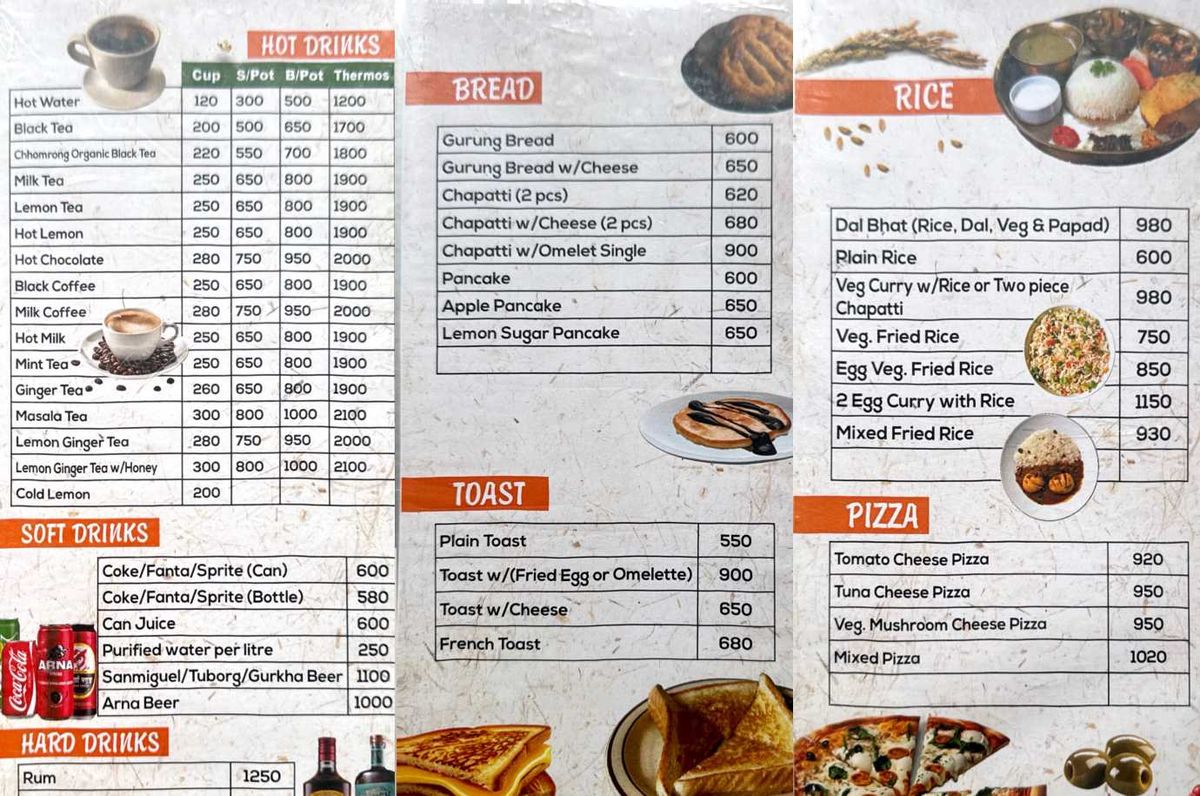
This is the number that varies most between trekkers. Someone who eats light and sticks to basics will spend meaningfully less than someone who orders frequently and adds snacks throughout the day. A bundled package can't account for that difference, which is why bundled food costs often end up being overestimates for lighter eaters.
One thing worth knowing: teahouses along the trail generally expect guests to take their meals there. It's standard practice, not a restriction; meals are the primary income source for teahouse owners, and the accommodation pricing is built around that assumption. This doesn't limit your flexibility much in practice, since you're still choosing what you order and how much.
2) Porter
A porter carries your bag so you can focus on the walk. Whether you need one depends on your fitness, pack weight, and personal preference.
On well-established routes like ABC or Langtang, many trekkers carry their own bags without issue. Others prefer a porter from the start, and some hire one only for the higher sections.
A porter costs around $20-$25 per day. One porter is typically shared between two trekkers to reduce the cost to half per person. Solo trekkers pay the full amount. It's optional, and the decision is entirely personal.
3) Extras on the Trail
Teahouses charge separately for things like:
- Hot shower: $1 to $3
- Wi-Fi: $1 to $3 per day (where available, and it's slow)
- Device charging: $1 to $2 per device
- Snacks outside meal times
These are small individually but can add $30 to $60 to your total if used regularly throughout the trek. Worth factoring in if you know you'll use them.
Why This Cost Distinction Matters When Choosing a Provider
When an agency gives you a single bundled price, you lose clarity into both categories.
More importantly, you can't adjust. If you eat less than the assumed daily amount, you don't save anything. The flexibility that should exist in the personal spending side disappears entirely.
The cleaner approach is to pay for the fixed logistics upfront at a clearly stated price, and handle personal daily expenses directly on the trail. This way:
- You know exactly what the essential costs are
- Your daily spending reflects what you actually consume
- More of your money goes directly to local teahouse owners and communities
- There are no surprises at either end
It's not about spending less for the sake of it. It's about spending accurately, on what you actually use.
One Cost That's Never Optional: Travel Insurance
Regardless of how you manage everything else, travel insurance for a Nepal trek is non-negotiable. Your policy should cover emergency helicopter evacuation, high-altitude sickness, and medical evacuation. On routes that reach 4,000 meters and above, these are real scenarios, not unlikely ones.
A suitable policy typically costs $50 to $150 depending on your home country and coverage level. Build this into your overall trip budget from the start.
In Summary
Trekking in Nepal has two distinct cost layers:
Fixed: Guide, permits, transport, and teahouse accommodation. These are set, non-negotiable, and should be clearly stated before you book anything.
Flexible: Food, porter, and daily extras. These depend on your preferences and habits, and are best managed directly on the trail.
Understanding this distinction helps you budget accurately, choose the right provider, and arrive at the trailhead without financial surprises.
Nepwise Adventures organizes treks in Nepal on exactly this model. Fixed logistics are handled upfront professionally, and personal on-trail expenses stay in your hands. If you're planning a trek and want a clear picture of what it actually costs, start with any of the trek pages on nepwise.com.

Sanjiv Jaiswal
Co-founder | Technology & Growth Lead
Sanjiv leads technology and growth at Nepwise.
He works closely with guides, operators, and trekkers to design systems that bring clarity to trekking and travel logistics, pricing, and planning. His work focuses on making complex aspects of trekking in Nepal more transparent and understandable.
He is part of the team building Nepwise Adventures around the belief that adventure travel in Nepal should be easier to understand, more transparent, and centered on helping travelers make informed decisions.