Accommodation in the Everest Region
Accommodation in the Everest region is provided through local tea houses. These are small, family-run lodges built specifically for trekkers. They offer a bed, meals, and warmth at the end of a long walking day.
As you gain altitude, comfort changes naturally. Lower villages feel relatively easy, while higher villages become simpler, colder, and more practical. This gradual shift is a normal part of trekking in the Everest region and something every trekker experiences.
With Nepwise, accommodation is arranged in advance for the group. Along the Everest trail, especially during peak season, lodges can fill up quickly, and villages have fixed stopping points.
Accommodation is included in the base package and managed by Nepwise, so you don’t need to arrange or pay for it separately during the trek.
What staying in these lodges actually feels like
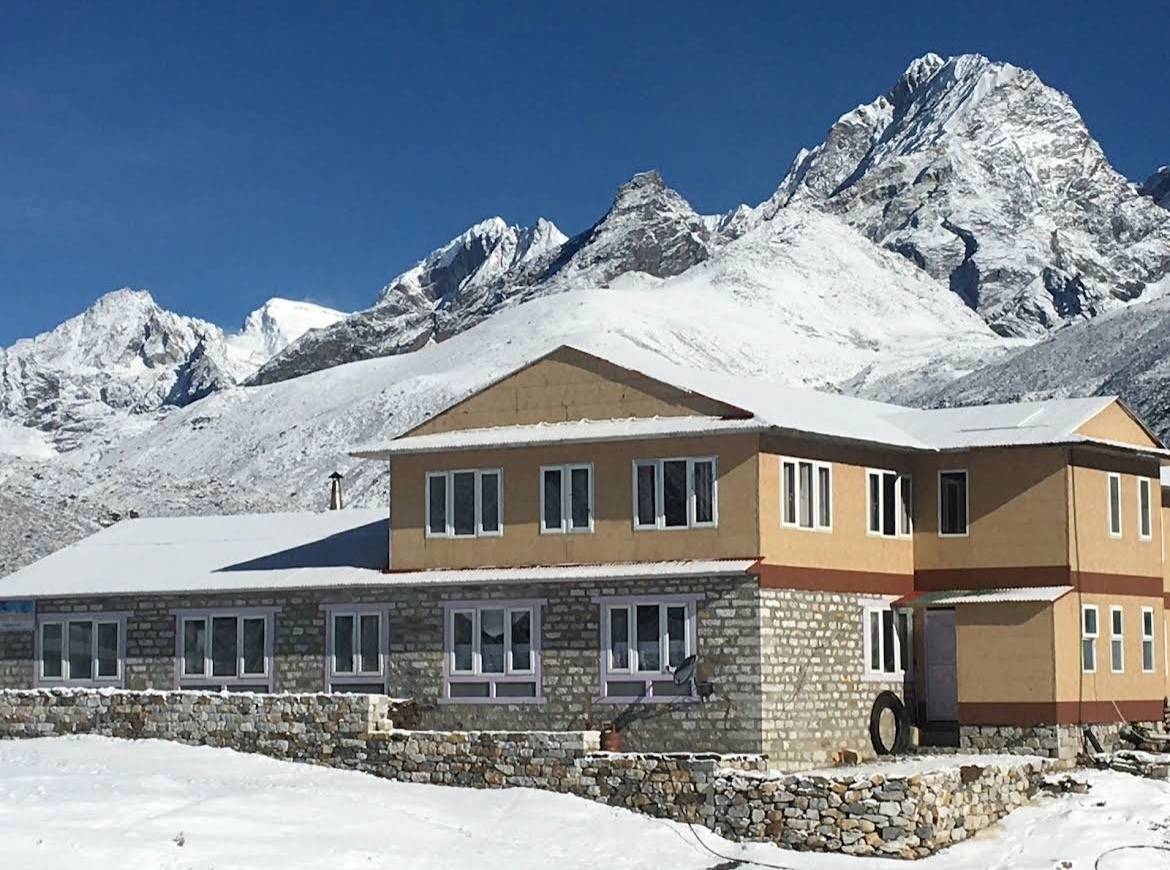
"Everst Trekkers Hotel at Pheriche"
In lower villages such as Lukla, Phakding, and Monjo, rooms are typically twin-sharing with proper beds and mattresses. Bathrooms are shared, and hot showers are often available for an extra charge. Charging phones and basic Wi-Fi are commonly available, though not guaranteed.
As you move higher to places like Namche Bazaar, Tengboche, Dingboche, and Pheriche lodges become more basic. Sleeping rooms are not heated, so evenings are usually spent in the dining hall, where trekkers gather around the stove to eat and warm up. Charging and Wi-Fi are still available in many lodges but become slower and more expensive.
At the highest villages, such as Lobuche and Gorakshep, accommodation is very simple and focused on rest. Rooms are small, facilities are limited, and nights are cold. Electricity is limited, hot showers are rare, and a good sleeping bag becomes more important than the lodge itself.
Rooms and sharing expectations
Room sharing is standard on the Everest trail and should be expected, particularly during busy trekking months such as October–November and April–May.
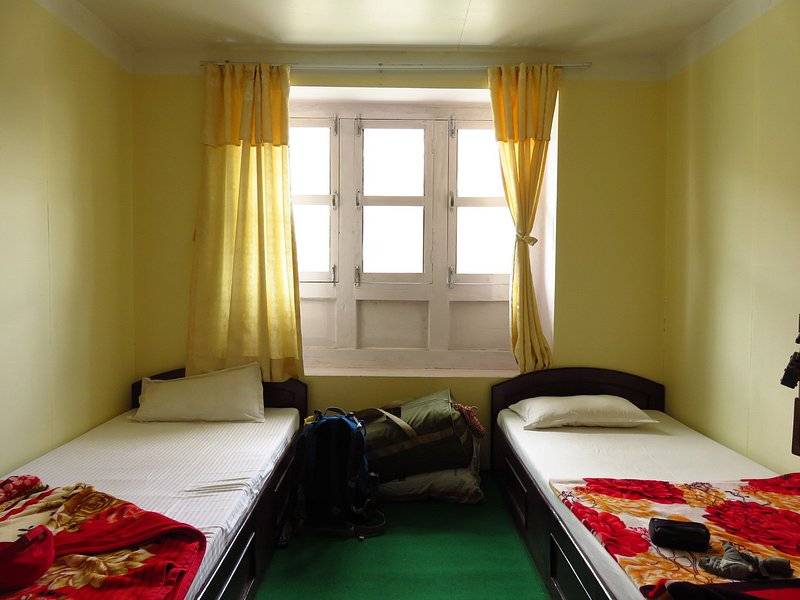
“Typical twin-sharing room in the Everest region | Image via Hotel Bright Star”
Most tea houses along the route are designed for twin sharing. Private rooms are rare and are not part of the planned accommodation, especially at higher villages where they often do not exist at all.
If a private room happens to be available on a given night, the guide will inform you on the spot. Nepwise does not plan for or promise private rooms on the Everest trail.
Commonly Used Tea Houses Along the Everest Trail
Along the Everest trekking route, accommodation is coordinated at specific tea houses based on fixed village stops and limited lodge availability in the region.
Accommodation is arranged in advance. In rare cases where a listed lodge is unavailable due to weather, group size, or trail conditions, an alternative lodge of similar standard is arranged nearby.
Village / Area | Commonly Used Tea House |
|---|---|
Lukla | |
Phakding | |
Namche Bazaar | |
Tengboche | |
Dingboche | |
Pheriche | |
Lobuche | |
Gorakshep |
Wi-Fi, charging, and small extras
Wi-Fi, charging devices, and hot showers are treated as optional extras rather than basic services. Costs increase with altitude, and availability depends on weather and solar power.
Wi-Fi typically costs NPR 200–500 per day at lower elevations, rising to NPR 500–1,000 or more above 3,500m. Speeds are slow enough for messaging but unreliable for calls or uploads. Device charging runs NPR 200–500 per charge, lower down and NPR 500–1,500 above 4,000m, where solar is the only source.
Charging takes place in common areas, so a power bank is worth carrying. Hot showers cost NPR 300–600 at lower stops and NPR 600–1,500 higher up; mid-afternoon is the best window before solar-heated water runs out. Above Dingboche, they become scarce.
Boiled or filtered water from the teahouse kitchen (NPR 100–200 per liter) is cheaper and more responsible than bottled water, which can reach NPR 400–600 near base camp.
As a rough guide, budget an extra NPR 1,000–2,500 per day for these small extras.
Toilets and hygiene
Most tea houses have squat-style toilets in a separate block. Western sit-down toilets are common lower down but rare above Tengboche, where pit or dry toilets become the norm. Cleanliness varies by lodge and how busy the trail is.
Toilet paper is not provided, carry your own, and always put used paper in the bin rather than the toilet. Hand sanitizer is essential; hot water for handwashing is rarely available. Use it consistently, especially before meals.
There are no public toilets on the trail between villages. When nature calls mid-hike, step well off the trail and away from any water source. Carry a small amount of toilet paper and hand sanitiser in your daypack at all times.
Last updated: May, 09, 2026